
Entering the arena of public procurement is one of the most reliable strategies for scaling an emerging contracting venture. While private sector work often relies on shifting economic conditions, real estate sentiment, and discretionary capital, municipal, state, and federal agencies continuously fund public works to maintain critical infrastructure. For an ambitious entrepreneur, securing a government contract offers guaranteed payments, public recognition, and the prestige required to win even larger awards down the road.
However, transitioning from residential renovations or minor commercial assignments into public sector construction demands a fundamental shift in operational thinking. Public agencies do not operate on informal handshake agreements or casual estimates. Every dollar spent is governed by statutory mandates, strict transparency laws, and standardized procurement regulations. Entering this domain requires a strategic approach that pairs operational readiness with an intimate knowledge of bidding administrative requirements.
Establishing Financial and Operational Baselines

Before drafting a single proposal, your business must establish strong fiscal and operational hygiene. Public entities evaluate an applicant’s financial stability just as intensely as they evaluate past craftsmanship. Agencies require audited balance sheets, credit lines, and proof that your enterprise can absorb operational costs long before public reimbursements clear. Working capital must be kept liquid, ensuring that daily expenses such as payroll and equipment rentals proceed uninterrupted during lengthy review cycles.
Beyond simple cash flow management, understanding the legal boundaries of corporate stability is vital. Government evaluators run comprehensive risk profiles to verify that an entity has never violated commercial codes or required shelter under bankruptcy law during previous business dealings. Demonstrating clean corporate records, strong liquidity, and transparent accounting safeguards your standing against competitors whose unvetted finances disqualify them during pre-award investigations.
Structuring Legal Registrations and Profile Compliance
Every agency requires prospective vendors to register through designated commercial directories before participating in open solicitations. At the federal tier, this requires securing a Unique Entity Identifier and completing registration in the System for Award Management. State departments of transportation and municipal general services administrations maintain their own distinct vendor directories. Neglecting to complete these profiles thoroughly will disqualify your bids before technical evaluations even start.
- Secure your Employer Identification Number directly from tax authorities and match all business name spellings precisely across corporate registrations.
- Complete registration on federal databases, identifying your appropriate North American Industry Classification System designations.
- Enroll in your local municipality and county vendor portals to ensure notifications for regional capital improvement projects arrive promptly.
- Maintain an organized repository containing certificates of good standing, utility licenses, and articles of organization for instant retrieval during solicitations.
Navigating Solicitations, Set-Asides, and Certifications

Public contracting programs maintain specific socioeconomic initiatives designed to level the playing field for small, disadvantaged, and emerging enterprises. If your venture qualifies under any certified demographic designations, pursuing these programs can fast-track your progression from an unknown entity to an active prime or trade partner.
Leveraging Small Business Socioeconomic Designations
Federal and state agencies establish annual goals to allocate significant portions of construction budgets to certified enterprises. These include Small Business Administration designations such as 8(a) Business Development, Historically Underutilized Business Zones, Service-Disabled Veteran-Owned Small Businesses, and Women-Owned Small Businesses. State and municipal frameworks offer comparable certifications, frequently categorized as Minority Business Enterprises or Disadvantaged Business Enterprises.
Winning work through these preference programs allows smaller companies to bypass mega-contractors that dominate unrestricted procurements. For instance, when federal infrastructure projects require specialized site alterations, agencies frequently restrict bidding to certified small entities. Whether an agency plans a remote municipal outpost or contracts out facilities upkeep, being certified enables you to compete within a significantly smaller and more manageable pool of peers.
Identifying Realistic Entry-Level Opportunities
New companies should rarely begin by pursuing hundred-million-dollar infrastructure megaprojects. The most sustainable path to growth lies in pursuing small purchase thresholds, micro-purchases, and simplified acquisition procedures. Many regional entities can award projects under specified financial limits without issuing cumbersome, months-long public solicitations.
- Target regional park repairs, administrative building renovations, and utility easement clearances that fit your immediate crew capacity.
- Review simplified acquisition thresholds on state procurement boards, which frequently allow rapid turnaround times and lower bonding minimums.
- Monitor municipal school board agendas and water district notices for emergency remediation tasks requiring rapid deployment.
- Analyze past procurement records through Freedom of Information Act requests to observe winning pricing trends on standard maintenance tasks.
Site Logistics and Commercial Waste Management Protocols
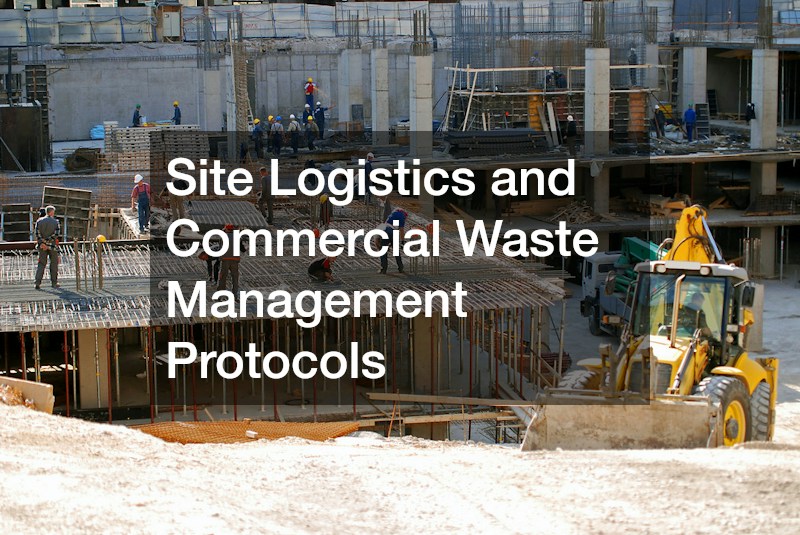
Winning a government bid is only the first hurdle; executing the project according to strict contract stipulations is where profitability is decided. Public works sites are scrutinized continuously by field inspectors, environmental protection monitors, and city engineers. Establishing a safe, orderly, and hygienic job site from day one prevents costly citations and stop-work orders.
Establishing Sanitation and Crew Support Facilities
Public contracts contain detailed provisions regarding worker welfare, site amenities, and hygienic compliance under federal and state safety rules. Failing to provide adequate biological facilities can shut down a site within hours of an unscheduled labor inspection. Depending on the size of the footprint and the number of trades operating simultaneously, procurement officers inspect physical sites to verify adequate contractor preparations.
To satisfy both Occupational Safety and Health Administration mandates and specific contract hygiene covenants, securing a reliable porta potty placement plan is mandatory for every project footprint lacking permanent plumbed amenities. Furthermore, procurement specifications often mandate that support trailers and physical staging compounds feature professional visual displays such as approved business signs to denote restricted zones, emergency muster points, and official agency partnership credentials.
Executing Environmental Waste Diversion Plans
Modern public infrastructure contracts routinely enforce strict environmental sustainability metrics. Major green building rating benchmarks and civic waste ordinances require contractors to divert significant volumes of discarded materials away from standard municipal landfills. Incorporating clear waste management workflows into your initial site planning ensures regulatory compliance and protects your project timeline.
- Partner early with a licensed construction dumpster rental service that provides manifest tracking slips confirming total tonnage and dump sites.
- Implement a rigorous on-site sorting station to separate timber, drywall, untreated masonry, and packaging materials before disposal.
- Route discarded structural remnants, ducting, and piping toward certified scrap metal recycling processors to turn scrap into reclaim credits.
- Archive every hauling receipt and diversion certificate in a shared project ledger to submit alongside monthly agency billing applications.
Field Preparation, Trades Collaboration, and Subcontracting

A newly licensed general contractor cannot self-perform every trade on a comprehensive public works project. Government agencies look favorably on prime contractors who exhibit the executive capability to coordinate multiple specialty trades while maintaining absolute control over quality, schedules, and safety protocols.
Organizing Land Prep and Pre-Construction Verification
Before breaking ground or disturbing soil, comprehensive site verifications must take place. Discrepancies between historical civic plans and actual topographical conditions represent a primary driver of cost overruns and public disputes. Smart builders verify physical property boundaries, utility depths, and structural elevations through independent evaluations before mobilizing heavy equipment.
Experienced builders routinely commission certified land survey companies to map project coordinates and produce stamped topographic profiles. Early validation of soil density and grade prevents grade failures that can delay foundation installation. By resolving discrepancies during pre-construction meetings, a proactive builder secures necessary design adjustments through formal requests for information rather than facing project stoppages later.
Assembling Reliable Specialty Trade Partners
Government agencies inspect specialized structural components with zero tolerance for amateur workmanship. When project drawings call for structural reinforcements, seismic upgrades, or high-pressure utility pipes, partnering with licensed, vetted trade specialists is essential.
- Contract dedicated welding repair services early to address unexpected structural revisions, heavy machinery breakdowns, or steel tie-ins.
- Ensure all trade specialists carry commercial liability coverage that lists the contracting public entity as an additional insured party.
- Require prospective trade partners to supply safety logs and experience modification rates matching the primary contract standards.
- Establish clear pay-if-paid or pay-when-paid frameworks aligned with public reimbursement timelines to protect cash reserves.
Balancing Commercial Disciplines with Residential Experience
Many builders transition into municipal work after operating successfully within the private market. While running a residential framing or renovation operation builds fundamental construction knowledge, institutional jobs present a vastly different set of regulatory challenges. The meticulous documentation required for public infrastructure far exceeds standard residential agreements.
A tradesperson who previously operated a house construction company can translate foundational knowledge of framing, concrete, and finishes into light municipal work. However, working as a local construction contractor for an urban redevelopment agency involves complying with local prevailing wage laws, apprenticeships, and administrative audits. Mastering these statutory practices allows builders to cross the bridge from private building projects into dependable civil works.
Navigating Labor Compliance, Wage Laws, and Jobsite Safety
Public sector construction projects are bound by specialized labor regulations created to protect workers and maintain regional wage baselines. Overlooking these employment rules can lead to project debarment, financial withholdings, and civil penalties that can permanently paralyze a young company.
Mastering Certified Payroll and Prevailing Wage Rules
The federal Davis-Bacon Act and individual state “Little Davis-Bacon” statutes mandate that all laborers working on public works projects receive locally prevailing wages and fringe benefits. These rates are determined by the Department of Labor based on specific craft classifications, geography, and task descriptions.
Prime contractors must collect, audit, and submit weekly certified payrolls using standardized federal forms like the WH-347 or equivalent digital reporting portals. Every classification, from general laborers to specialized equipment operators, must be logged with complete precision. Even minor calculation errors or craft misclassifications can hold up broad disbursements across the entire project team.
Establishing Comprehensive Health and Safety Programs
Safety protocols on government job sites are governed by explicit contract specifications that supplement baseline federal requirements. Agencies frequently assign on-site safety coordinators who possess stop-work authority if they spot violations of fall protection, trench safety, or personal protective gear standards.
- Conduct daily morning toolbox talks focusing on task-specific risks, logging individual worker attendance sheets religiously.
- Mandate proper job site gear, including approved high-visibility vests, hard hats, eye protection, and industrial protective footwear for all personnel entering the perimeter.
- Maintain fully stocked first-aid enclosures, eyewash units, and clear evacuation pathways throughout every phase of construction.
- Designate an OSHA-certified competent person on-site whenever high-risk operations such as scaffolding or excavation take place.
Winning the Award: The Art of Government Estimating and Proposals
Submitting a bid for a government project requires an entirely different methodology than bidding on residential or light private commercial work. In the private sector, personal chemistry and high-level estimates often close deals. In the public sector, awards are determined either by the lowest responsive and responsible bid or through a formal best-value determination scored against published evaluation criteria.
Deconstructing Requests for Proposals and Invitations for Bids
Invitations for Bids are generally awarded strictly on price, provided the bidder satisfies all administrative prerequisites. Requests for Proposals, conversely, evaluate past performance, project narratives, staffing plans, and technical methodology alongside price. Thoroughly examining solicitation documents prevents disqualification over minor clerical oversights.
- Review the scope of work line by line, tagging every mandatory submission form, certification attachment, and bond document.
- Attend all non-mandatory and mandatory pre-bid conferences to hear agency priorities and observe prospective competitors.
- Submit clear, written questions before the formal deadline to clarify ambiguities in design schematics or spec books.
- Ensure all proposal addenda issued by the purchasing agent are explicitly acknowledged within your primary bidding packet.
Crafting Transparent, Responsive, and Defensible Cost Estimates
Public estimators must price projects with surgical precision. Overbidding will exclude you from competitive consideration, while underbidding can lock your company into a binding contract that drains operating capital. Every cost element must be documented, defensible, and reflective of prevailing wage adjustments and volatile material indexes.
Factor in indirect requirements that private clients rarely require, such as site security, certified payroll processing overhead, specialized safety certifications, and warranty bonds. Maintaining a clear paper trail for all vendor and subcontractor price commitments protects your cash margins against supplier price spikes between proposal submission and contract award.
Delivering the Work and Building Institutional Past Performance
Winning your first government contract is a notable milestone, but the true prize is the creation of exceptional past performance references. In the government ecosystem, an established record of delivering projects on time, within budget, and without safety incidents is your most valuable business asset.
Managing Change Orders, Pay Applications, and Administrative Approvals
Public contracts are executed through structured administrative workflows. When unexpected conditions arise in the field, work cannot proceed based solely on a casual verbal nod from an inspector. Every adjustment requires a formal request for information, a detailed cost change proposal, and a signed change order modification before compensation is secured.
- Use industry-standard forms, such as AIA G702 and G703 or agency equivalents, for monthly progress billing submittals.
- Submit detailed submittals, product data sheets, and mockups early in the schedule to prevent delivery delays.
- Keep comprehensive daily logs containing weather notes, equipment usage, working headcount, and photographic records of work in progress.
- Issue written notices of latent conditions within the precise window defined in the general conditions of your contract.
Converting Completed Contracts into Long-Term Agency Growth
Upon substantial completion, projects transition into the punch-list and closeout phase. This involves producing final operational manuals, as-built CAD files, lien releases, and final warranty packages. Federal, state, and local agencies compile formal contractor performance evaluations at this juncture, assessing management efficiency, craftsmanship, and safety performance.
Federal agencies file official ratings into the Contractor Performance Assessment Reporting System. Outstanding scores in this database serve as your calling card for subsequent bids, validating your capability to handling larger capital works. Over time, this compounding record of public trust transforms an emerging builder into an established, resilient enterprise equipped to compete and succeed across the public works sector.
Transitioning into public sector contracting requires patience, structural discipline, and an unwavering commitment to administrative precision. The path from initial vendor registration to final closeout requires mastering complex bidding formats, managing strict jobsite regulations, coordinating diverse specialty trades, and maintaining rock-solid financial accountability.
While the learning curve is demanding, the rewards offer stability and scalable growth that private market cycles rarely match. Builders who treat compliance, safety, and meticulous documentation as core operational disciplines will find that public contracts provide a dependable foundation for long-term commercial success.


